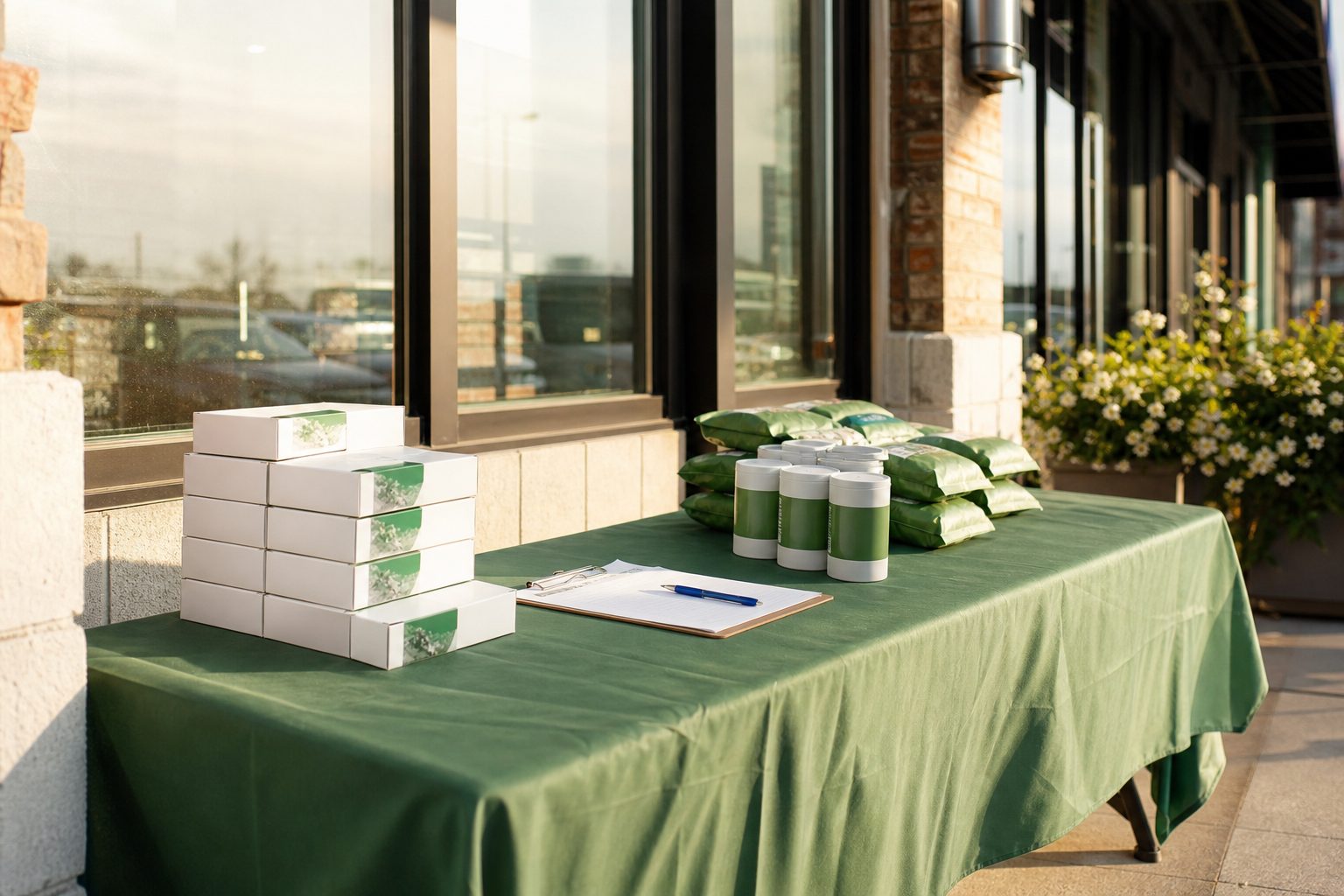
A two hour booth shift earns your troop the number of packages you sell multiplied by your council's troop proceeds per package, minus a small allowance for damaged stock and any site fee. If your council pays your troop a fixed amount per package and your booth moves packages at a steady rate, the arithmetic is short and you can do it before you commit a family to a Saturday.
The honest answer to "how much" is that it varies by a factor of three or more between a strong site and a weak one, which is exactly why a season total is a useless planning unit and a per shift figure is not. What you want is your own number, built from your own council terms and your own site history.
Below is the build, step by step, with a worked example you can substitute your real figures into. Every number in the example is labeled as an assumption, because your council's proceeds rate and your region's traffic are yours to look up, not mine to assert.
Where troop proceeds per package come from in council terms
Councils publish a proceeds structure before the season opens. It usually appears in the troop product program guide or the volunteer agreement, and it typically has these moving parts:
- A base per package amount the troop keeps from each package sold.
- A tiered bump, where troops passing a per girl average earn an extra amount per package on all packages, not just the ones above the line.
- An opt out choice, where troops that decline individual recognitions earn a higher per package rate.
- Cookie share or gift program packages, which often carry a different proceeds treatment than a package handed to a customer.
Find the exact base and the exact tier thresholds for your council this season and write them at the top of your planning sheet. Do not use last year's numbers and do not use a neighboring council's. Proceeds rates differ across councils and they change.
Note also what proceeds are not. The package price the customer pays is council revenue. Your troop keeps only the proceeds portion. A troop that plans against the retail price will overstate its earnings by a large multiple.
Keep reading: What actually happens during a cold weekend booth shift outside a grocery store?
Turning packages per hour into a per shift figure
The core formula is simple:
Shift earnings = packages sold in the shift x troop proceeds per package, minus deductions.
And packages sold is itself:
Packages sold = transactions per hour x packages per transaction x hours.
Here is a worked example. Every input is an assumption you should replace.
| Input | Assumed value | Where you get the real one |
|---|---|---|
| Shift length | 2 hours | Your booth schedule |
| Transactions per hour | 18 | Count them at your next shift |
| Packages per transaction | 2.5 | Your tally clipboard |
| Packages sold | 90 | 18 x 2.5 x 2 |
| Troop proceeds per package | $0.95 | Your council program guide |
| Gross troop earnings | $85.50 | 90 x 0.95 |
That is the whole engine. Change one input and you can see immediately what it is worth to fix. Lifting packages per transaction from 2.5 to 3.0 in the same shift adds 18 packages, or about $17 in troop proceeds at the assumed rate. That is what a girl who says "most families take three" instead of "would you like some" is actually worth.
How site type changes traffic and average basket
Two of the three inputs above are set by the site, not by effort. Transactions per hour is largely a function of how many people walk past you and how willing they are to stop. Packages per transaction moves with the shopper's mindset.
- Grocery entrance. High foot count, shoppers already carrying a wallet, strong packages per transaction. Usually the most contested site in the service unit.
- Home improvement or warehouse store. Lower foot count per hour but larger baskets. Weekend contractors and families buying in bulk often take four or more packages.
- Pharmacy or bank. Steady but thin traffic, quick errands, small baskets. Fine for a first shift with new girls, weak for revenue.
- Community event or church after service. Traffic arrives in a wave rather than a stream. Your two hour window may hold one twenty minute rush and ninety quiet minutes.
- Drive up or lemonade style neighborhood booth. Very low transaction count, but zero competition and often high per transaction generosity.
Because site drives so much of the outcome, the useful thing to track is not a troop wide average but a per site average. A site that produced 120 packages last February will likely produce something similar this February at the same day and hour.
Keep reading: How do I set up a booth sale permit and site agreement before our first weekend?
Fees, damaged stock and other deductions to subtract
Gross is not net. Subtract these before you report a shift figure to parents.
- Site fees. Some venues, particularly malls and larger events, charge a table fee. Divide it across the shifts you run there.
- Damaged or unsellable packages. Crushed boxes, rain damage, a package that hit the parking lot. Council policy on damaged product varies, so check whether you can return it. If you cannot, the troop absorbs the full package price, not the proceeds amount, which is a much bigger hit.
- Card processing. If your council supplies the reader, processing is often covered centrally. If your troop uses its own merchant account, subtract the per transaction and percentage fee.
- Consumables. Bags, tape, hand warmers. Small, but real, and worth funding from troop money rather than a parent's pocket.
One crushed package at a six dollar price wipes out the proceeds from roughly six sold packages at a ninety five cent rate. That ratio is the entire argument for the tarp and the sensible stacking.
Comparing a booth hour against a door to door hour
Leaders often assume booths are the efficient channel. Compare them properly, per adult hour, because adult hours are your scarcest resource.
| Booth shift | Door to door | |
|---|---|---|
| Adults required | 2 minimum, per council ratio | 1 per girl or small group |
| Girls served per adult hour | Often 3 girls across 2 adults | 1 to 2 |
| Earnings credited | Split across the troop or per council rule | Credited to the individual girl |
| Prep overhead | Loading, permits, setup, tear down | Minimal after initial inventory |
| Weather exposure | Total | Partial |
The comparison usually lands here: booths move volume and build the skill of asking a stranger, while door to door builds individual totals toward recognitions. A season plan needs both, and the mix is a decision about what your families can actually staff.
See how TroopBooth handles this for youth troop and club fundraising
Setting a goal per shift instead of a season total
A season goal of, say, three thousand packages tells a volunteer nothing on a Saturday morning. Convert it.
- Take your season package goal.
- Subtract the packages you expect from individual selling and pre orders.
- Divide the remainder by the number of booth shifts you have secured.
- That quotient is the per shift goal. Write it on the count sheet.
If the quotient comes out above what your best site has ever produced in two hours, you do not have a motivation problem. You have a shift count problem, and the fix is more sites or longer shifts, decided now rather than in the last week.
Tracking actuals so next season starts from data
Every shift should end with four recorded numbers: packages sold by variety, cash collected, card collected, and the count of transactions. Transactions is the one most troops skip and the one that makes next year's forecast real, because it separates a traffic problem from a pitch problem.
Keep them by site and by day part. After one season you will know that the Saturday ten to noon slot at a particular entrance beats the Sunday afternoon slot by a wide margin, and you will bid for it accordingly.
Where to keep the numbers
None of this survives on paper across a season. TroopBooth records each booth shift with its roster, the cases assigned per member, and the cash and card totals reconciled against product removed, so your per shift and per site averages build themselves as the season runs. When a parent asks what their daughter's shifts contributed, the balance sheet answers without a shoebox of receipts. Enter your council's proceeds rate once and start logging shifts, and next January you will plan from your own history instead of a guess.