It is heading toward a booth that is half sales counter and half fulfillment desk. Cash is no longer the default tender at a public table, and the practical consequence is that the shift lead's job has changed: she is now reconciling three revenue streams instead of counting one. Card taken at the table, orders placed through a digital storefront while a shopper stands in front of her, and donation purchases that never involve product leaving the table at all.
The direction of travel is clear enough from what site owners now require. A growing number of retail hosts, particularly larger chains, ask groups not to handle cash on their property at all. That is not a preference you can negotiate around on the morning of the shift, so the equipment question has already been settled for many troops by the people who own the sidewalk.
What has not been settled is who absorbs the processing cost, who reconciles a shipped order, and how a troop closes its books when a third of the weekend's revenue arrives days later. Those are the parts worth preparing for now.
What card acceptance changed about average booth sales
Two things change when a reader appears on the table, and both are about friction rather than persuasion.
The first is the cash ceiling. A shopper carrying eleven dollars buys two packages, not because she wants two, but because that is what is in her wallet. Remove the ceiling and the purchase is bounded by appetite instead. The second is the round number effect. Cash buyers gravitate to counts that make change easy. Card buyers do not think about change at all, so a four package sale is as easy as a three.
Neither of those effects has a number attached that you should trust from anyone who has not measured your own booths. If you want the figure for your troop, it is straightforward to get: record cash total and card total separately per shift, along with packages sold on each, and divide. Two weekends of shifts gives you an average ticket for each tender that is actually yours.
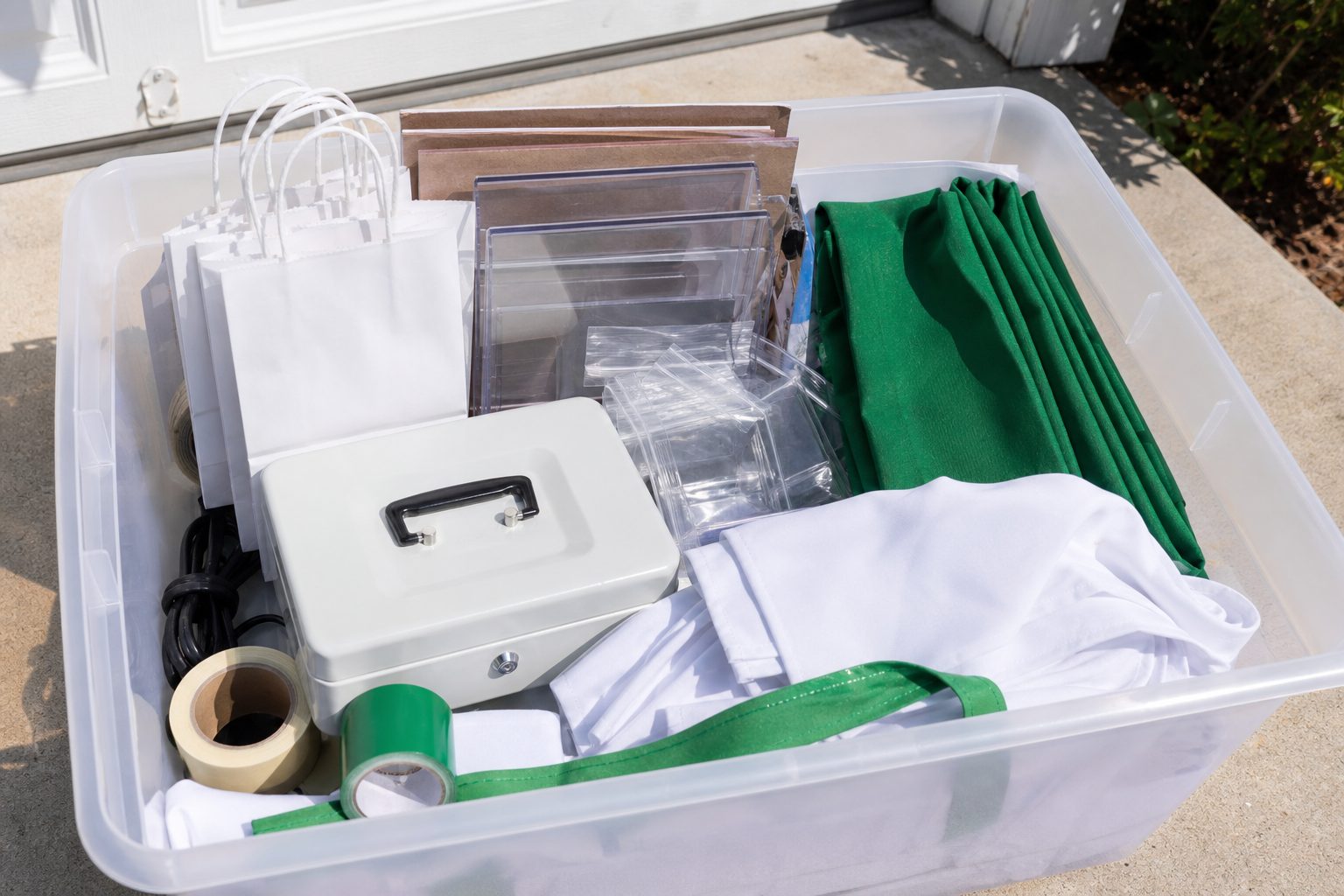
Keep reading: What should be in my booth kit box before I load the car on Saturday morning?
How digital storefront orders interact with physical inventory
A digital storefront order is a sale that does not touch your case inventory at the moment it is made, and this is where most troop bookkeeping goes wrong. The shopper at your table scans a code, orders on her phone, and walks away with nothing. Your case count is unchanged. Your revenue is not.
Two order types come out of that storefront, and they behave completely differently:
| Shipped direct | Member delivered | |
|---|---|---|
| Inventory source | Fulfillment warehouse, not your cases | Your cases, pulled after the fact |
| Payment | Collected online at checkout | Collected online at checkout |
| Troop action needed | None beyond credit tracking | Pull product, deliver, mark delivered |
| Risk to the troop | Effectively none | Undelivered orders and shrink |
| Credit to the member | Usually counted toward goals | Counted toward goals |
The operational rule that follows: never let a member delivered digital order sit unassigned to physical cases. The moment it comes in, it should draw down a specific member's assigned inventory, or you will finish the season with cases you cannot account for and orders you cannot prove you delivered.
Shipped versus member delivered orders and who reconciles them
Shipped orders reconcile themselves. The money went to the council or the fulfillment platform, the product went to the customer, and what reaches your troop is a credit line on a report. Your only job is to make sure the member got the recognition and the troop got the proceeds share.
Member delivered orders are troop liability. The customer has paid, so an undelivered order is not a bad debt, it is a complaint. The reconciliation is a three way match: order placed, product pulled from assigned inventory, delivery confirmed. Missing any leg of that is where a parent ends up driving across town in April with four boxes and an apology.
Assign a single adult to own the digital order queue for the season. Not the treasurer, not the booth chair. One person whose whole job is that the queue empties.
Keep reading: How much does a two hour booth shift actually bring in for our troop?
Processing fees and who absorbs them in council models
Card processing costs money, and the arrangement varies by council. There are three common structures, and it is worth knowing which one you are in before you set a troop budget.
- Council absorbed. The council covers processing across the program and the troop sees the full package price. Simplest for you, and the most common arrangement for the official card platform.
- Troop absorbed. The troop brings its own reader and the fee comes out of troop proceeds. You keep the full sale, you pay the processor.
- Split or capped. Council covers processing on the official platform only, and any outside reader is on the troop.
The arithmetic on a troop absorbed reader is easy to do in front of yourself. Take a common card processor rate of a percentage plus a fixed per transaction charge, apply it to a realistic ticket, and compare to a bigger one. Assume six dollars per package. A three package sale is eighteen dollars; at 2.6 percent plus fifteen cents, the fee is roughly sixty two cents, about 3.4 percent of the sale. A six package sale of thirty six dollars carries a fee of roughly one dollar nine, about 3.0 percent. The fixed component is what hurts small tickets, which is a direct argument for encouraging the larger buy rather than for refusing cards.
Confirm your own processor's current rate before using these figures. They are illustrative, not a quote.
Donation and gift to community programs
Gift to community purchases, where a shopper pays for packages that go to a food bank, military unit or first responders instead of home with her, are now a meaningful share of many booth totals, and they are the cleanest revenue you handle. No product leaves the table. No delivery obligation. Usually no sales tax question, though that depends on your state and your council's guidance.
They also solve the shopper who wants to support but does not want the product in her house, which at a booth is a larger group than most leaders expect. Teach the pitch explicitly, because members will not offer it unprompted: if someone declines, the follow up is the donation option, once, then thank her and move on.
Track donation units separately from sold units. They count toward member recognition and troop proceeds, but they do not move inventory in the same way, and blending them makes your case reconciliation lie.
See how TroopBooth handles this for youth troop and club fundraising
Site owners who now require cashless only
When a host requires no cash, plan for a specific set of second order effects rather than just bringing a reader.
- Confirm cell or wifi coverage at the exact table position, not at the parking lot. Vestibules are dead zones.
- Bring a charged battery pack. A tablet plus reader running four straight shifts will not last on its own charge.
- Have an offline plan. Know whether your reader stores transactions offline, and if it does not, know that a signal failure stops sales entirely.
- Post the accepted tenders on the table so shoppers stop asking, which saves your members thirty seconds every interaction.
- Still count a small change bank in case the rule is store policy rather than absolute, and confirm with the manager, not the greeter.
Preparing your troop for a mostly cardless weekend
The training shift matters more than the equipment. A member who has never operated a reader will hand it to an adult, and once that happens the member is no longer running the sale, which defeats the point of the program.
Run one practice session before the first weekend: a real transaction of a dollar or two, refunded, so every member has physically completed the tap and seen the receipt prompt. Then set the expectation that adults handle the reconciliation and members handle the customer.
At close of shift, the numbers you need are the same four regardless of tender mix: cases out, cases back, card batch total, cash counted. If those do not agree with packages sold at your local price, resolve it that evening.
What to set up before next season
Decide your fee model, name the owner of the digital order queue, split donation units out of your inventory math, and make the per shift close a habit rather than a rescue operation. Those four decisions cover most of what a cashless weekend throws at a troop.
TroopBooth is built for that reality: shifts and sites in one schedule, cases assigned and drawn down per member as digital orders land, cash and card totals reconciled per shift, and a parent facing balance sheet that stays accurate when the money arrives days after the table folds up.