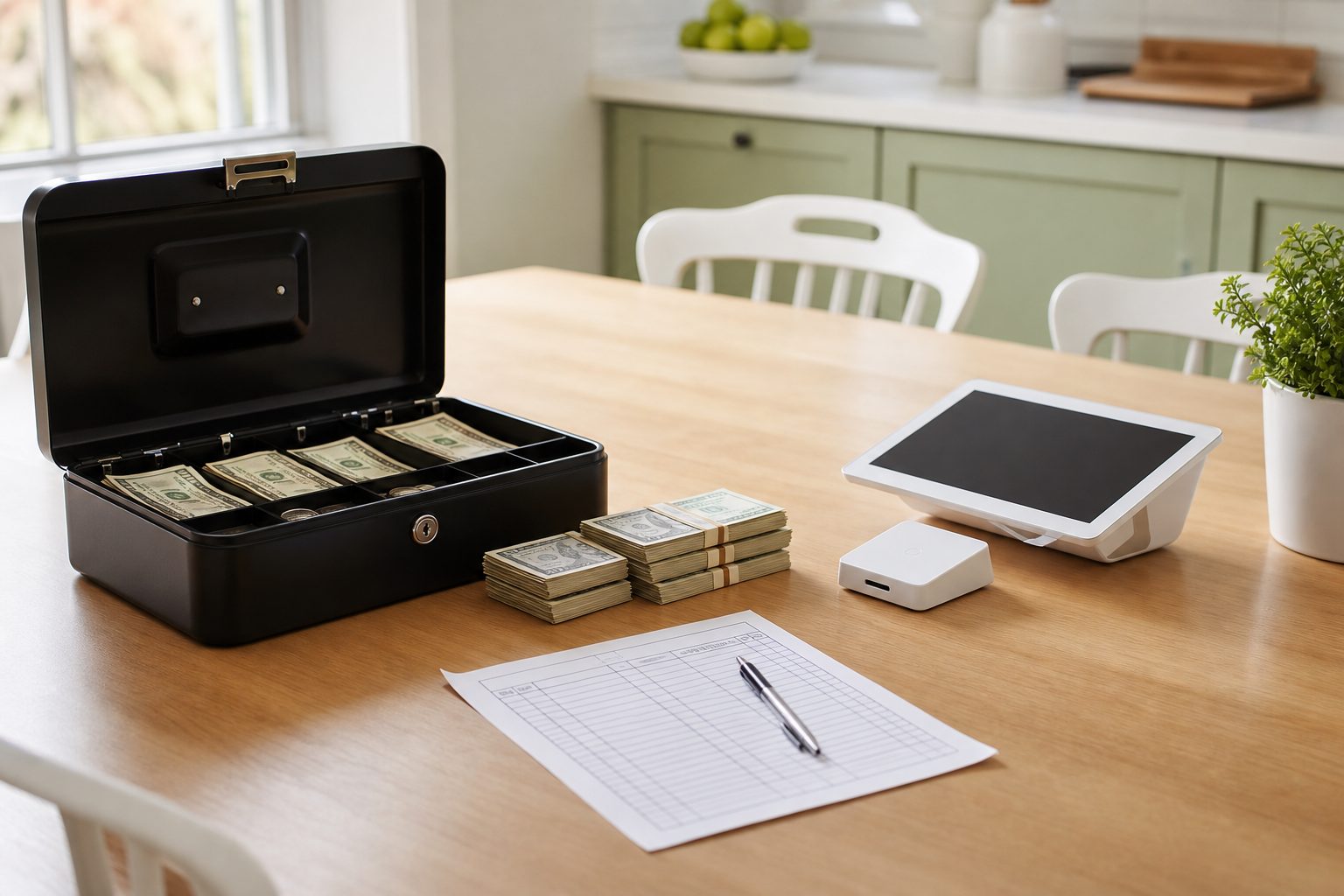
The expensive mistakes are not theft. They are custody gaps and unrecorded handoffs that make a shortfall impossible to trace, and by the time you notice, the money is three weekends old and nobody remembers who had the envelope. The four that cost troops the most, in order: single adult cash custody with no second count, family to family product handoffs nobody wrote down, card processing fees treated as invisible, and reconciliation postponed to the final week.
Every one of these has a structural fix that takes under five minutes per shift. Not a policy document, not a lecture at a parent meeting. A routine that happens whether or not anyone is paying attention, because the routine is built into how the shift starts and ends.
Here is what each mistake actually costs and what replaces it.
Letting one adult hold cash without a second counter
One adult opens the box, works the shift, closes the box, and takes it home. Nothing goes wrong most of the time. When something does go wrong, there is no way to tell whether the box was short at the start, whether a customer walked with a twenty, or whether the count at the end was simply rushed.
The cost is not usually the missing money. It is what happens next: a parent gets quietly suspected, another parent hears about it, and you lose two families for next season over eighty dollars.
The fix is a starting bank that is counted and initialed by two adults before the first sale, and a closing count that is done the same way, in the parking lot, before anyone drives off. Write both numbers down. Cash collected equals ending count minus starting bank. That single subtraction, done at the site, converts a vague feeling into a number.
Set the starting bank deliberately
A workable booth bank for a five dollar package price: forty ones, ten fives, and a roll of quarters if your council prices anything in halves. That is roughly ninety dollars. Whatever you choose, use the same number at every booth all season so the subtraction is always the same shape and an odd starting count stands out immediately.
Keep reading: What do child protection and volunteer screening rules require of us at a public booth?
Unlogged case transfers between families
A mom picks up eight cases from your garage on a Tuesday because she is doing a neighborhood run. She takes four and leaves four for someone else. Nobody writes anything down. In April, the council statement says the troop is responsible for those eight cases and you have money for five.
This is the largest dollar exposure on this list, because it scales with case value rather than with what fits in a cash box. Twelve packages per case at five dollars is sixty dollars of liability moving out of your garage with a wave.
The fix is a one line record at the moment of handoff, not later: date, member name, variety, number of cases, and who released it. A photo of a handwritten line works. What does not work is intending to log it that evening.
Apply the same rule to the reverse direction. Cases coming back into the garage are also a transfer and also change who owes what.
Treating card reader fees as free
Card acceptance at booths raises average sale size and prevents walkaways. It also carries a processing fee, and troops routinely budget as if the gross sale is the deposit.
Work it out with your own reader's published rate. Suppose a rate of 2.6 percent plus 10 cents per tap, and suppose these season assumptions for a mid sized troop:
| Line | Assumption | Result |
|---|---|---|
| Booth revenue on cards | $3,000 | $3,000 |
| Average card transaction | $20 | 150 transactions |
| Percentage fee | 2.6 percent of $3,000 | $78.00 |
| Per transaction fee | 150 times $0.10 | $15.00 |
| Total processing cost | $93.00 | |
| Effective rate | $93 on $3,000 | 3.1 percent |
Those are assumed inputs. Substitute your real rate and your real average ticket, because the per transaction charge is what makes small sales expensive. A single five dollar package on a card at the same rate costs 13 cents on the percentage plus a dime fixed, 23 cents total, an effective 4.6 percent. Bundle four packages into one twenty dollar sale and the same customer costs 62 cents, or 3.1 percent.
Two practical consequences. Encourage multi package purchases at the table, which customers usually want anyway. And budget the fee as a real season expense rather than discovering a ninety dollar gap between what the reader shows and what hits the bank.
The deposit timing trap
Card money arrives in the bank a day or several days after the sale, net of fees, and often batched. If you reconcile a booth by comparing that day's sales to that day's bank balance, the numbers will never agree. Reconcile card sales against the reader's own batch report, then confirm the deposit separately.
Keep reading: How did one troop clear four hundred cases in three weekends without burning out parents?
Accepting checks without a deposit and clearing rule
Checks at booths are less common than they used to be, but door to door orders still generate them, and they sit in envelopes.
Set three rules and state them once at the parent meeting. Checks are made payable to the troop, never to a person. Checks are handed to the treasurer within one week of receipt, not held until the end. And a family's balance is not considered settled until the check clears, because a returned check plus the bank's returned item fee lands on the troop.
Write the member's name on the memo line at the moment you accept it. A stack of checks with no attribution is a reconciliation problem you cannot solve without calling parents.
Mixing personal reimbursement with troop deposits
A leader buys tablecloths, a canopy weight and a box of gallon bags, then takes fifty dollars out of the cash box at the next booth to cover it. Reasonable. Also the fastest way to make a troop account unauditable.
Deposits go in whole. Reimbursements go out separately, against a receipt, recorded as an expense. Never net one against the other in the cash box, because the moment you do, the shift subtraction stops working and you have lost your only check on the day's cash.
Same principle for a parent who wants to pay their family's balance by handing cash to a leader at pickup. Fine, but it is a payment on that member's account and needs to be recorded as one, not folded into a booth deposit where it will look like booth sales.
See how TroopBooth handles this for youth troop and club fundraising
Waiting until the deadline to reconcile parent balances
The classic failure. Everything looks fine until the final week, then five families are short, two are unreachable, and the council payment date does not move.
Reconcile weekly instead, and make it visible. Every family should be able to see three numbers about themselves at any point: cases received, money turned in, and balance owed. When a parent can see their own number, they self correct. When only you can see it, you become the collections department in April.
A weekly rhythm that works:
- Sunday evening. Post the weekend's booth results and log any case transfers from the week.
- Sunday evening. Update each family's received and turned in totals.
- Monday. Send balances out. No commentary, just the numbers.
- Any balance over one week old and above a threshold you set, say the value of two cases, gets a direct message rather than a group note.
- Two weeks before the council deadline. Stop releasing new product to any family with an unresolved balance.
That last step is the one that requires a spine, and it is also the one that prevents most end of season losses. It is far easier to apply when it was announced as a standing rule in January rather than invented in March about one specific family.
Building a two signature routine that survives a busy weekend
All of the above collapses into a short opening and closing ritual that two adults perform at every shift. It should take four minutes.
Opening, before the first customer: count the bank out loud, both adults initial the sheet, note the case count on the table by variety, confirm the card reader connects with a test transaction.
Closing, before anyone leaves the lot: count remaining cases by variety, count the cash box, subtract the starting bank, write the cash figure, note the card reader batch total, both adults initial, photograph the sheet, then send that photo to the treasurer immediately.
The photograph is doing real work. It timestamps the count, it puts two witnesses on record, and it means the numbers exist somewhere other than a page that will spend the next four days in a minivan.
Making the routine the default
Every fix here is small. What makes them fail is that they depend on a tired volunteer remembering a procedure at 4 p.m. on a cold Saturday after two hours on asphalt.
TroopBooth puts the shift close out, the case count and the per member balance in the same place as the signup, so the closing numbers get entered once and the parent facing balance sheet updates itself. The families see their own totals, the treasurer sees the season, and nobody spends the last week of the season reconstructing a shoebox.