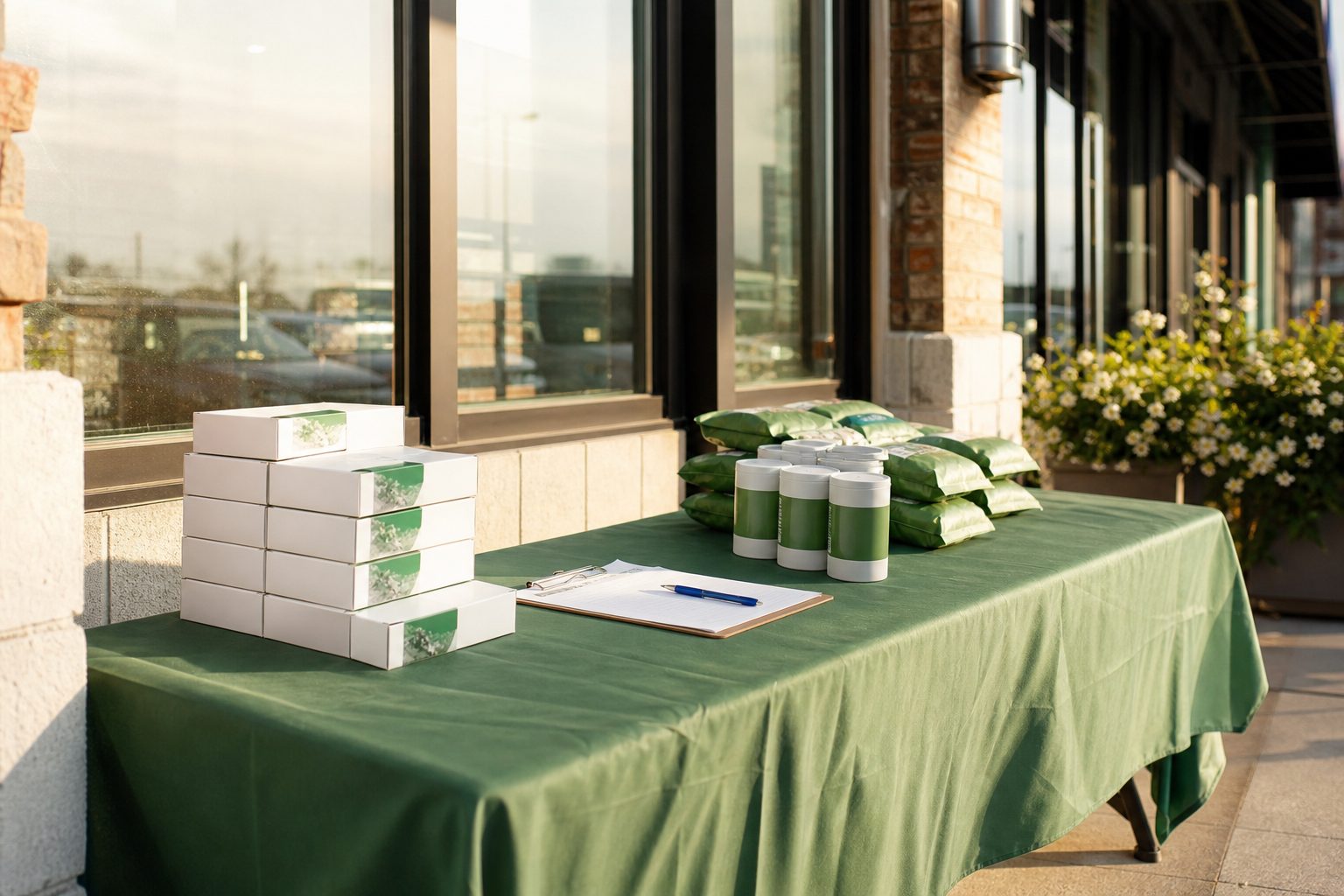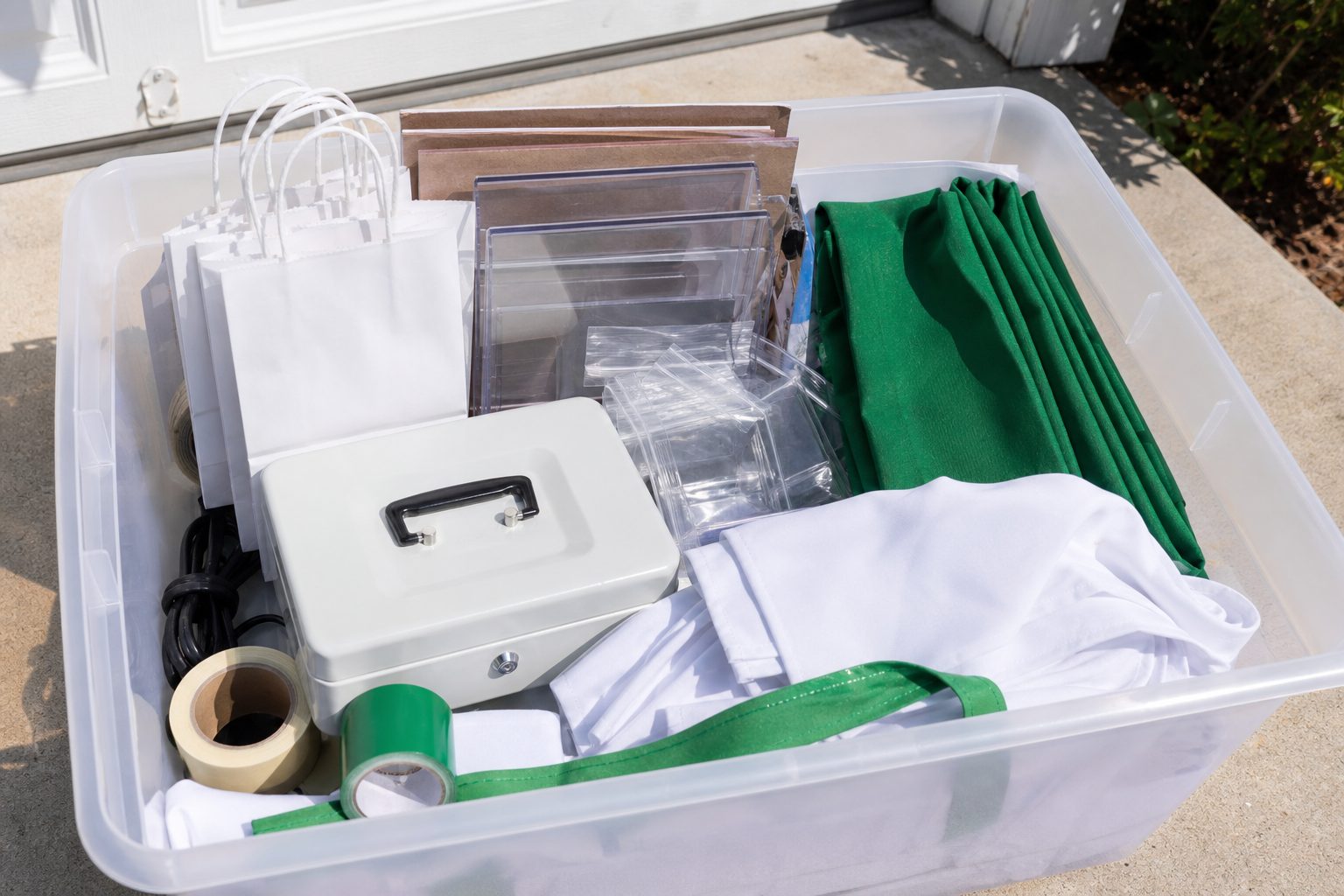
Your booth kit box needs seven groups of things: money handling gear, product and the paperwork that tracks it, the physical site setup, weather protection, permission and contact documents, comfort items for the girls, and the tear down supplies that let you hand off cleanly. If all seven groups are in one bin the night before, Saturday morning is a matter of lifting it into the trunk.
The reason to pack by group rather than by list is that emergencies at a booth cluster. You do not forget one thing, you forget a category. The leader who forgets the cash box also forgot the starting bank, because both live in the money group and the money group never got packed.
What follows is the full contents of a working bin, why each item is there, and the two routines that bracket the shift: the load check and the handoff.
Money items: cash box, starting bank, reader and backup
Cash is where a good shift turns into a bad reconciliation. Pack the money group as a sealed unit and never let it live loose in the bin.
- A lockable cash box with a working key, plus the spare key on a separate keyring in a different bag.
- A starting bank counted and recorded before you leave. For a five dollar package price, forty dollars in ones and four fives works. For six dollar pricing, carry more fives.
- A written count sheet showing the starting bank denomination by denomination, signed by whoever counted it.
- Your card reader, charged, with the app already logged in and a test transaction run at home. Readers that pair over Bluetooth will not pair for the first time in a parking lot with cold hands.
- A phone charging brick and the correct cable. A reader that dies at hour two costs you every card sale after it.
- A backup payment path: a second phone with the app installed, or a manual card entry option you have confirmed works on your account.
- A pen that writes on damp paper, and a second pen.
Why the starting bank gets its own sheet
At the end of the shift you subtract the starting bank from the box total to get cash sales. If nobody wrote down what went in, that subtraction becomes a guess, and a guess is how a troop ends the season eighty dollars short with no way to find it. Two minutes with a count sheet at the kitchen table removes that entire problem.
Keep reading: How much does a two hour booth shift actually bring in for our troop?
Product items: case count sheet, reserve stock, bags
Product is the group most often packed by feel. Feel is not a count.
- A case count sheet listing every variety loaded, by case and by loose package, with a signature line for the person who loaded the car.
- Product arranged so the top selling varieties are reachable and the slow movers are behind them. Sort in the driveway, not at the table.
- Reserve stock kept in the vehicle rather than under the table. Under the table it walks away, and it also gets counted twice.
- Bags. Small ones for a single package, larger for a multi package buy. Plastic grocery bags collected all year work fine and cost nothing.
- A price card in a stand, showing package price and any multi package pricing your council allows.
- A donation option sign if your council runs a gift program, with the exact wording your council supplies.
Load the car in case units and record it. If you leave with fourteen cases and four loose packages, the sheet says fourteen and four. Everything else in the reconciliation depends on that first honest number.
Site items: table, weights, signage frame, trash bag
The site group is what turns a patch of sidewalk into a booth that a shopper reads in three seconds from thirty feet away.
- A six foot folding table, or whatever the store permits. Some entrances only allow a four foot table against the wall.
- A vinyl or plastic tablecloth with clips. Fabric soaks up spilled hot chocolate and never dries.
- Four table clips or clamps. Wind is the most common site problem in winter and spring both.
- Weights for the signage: gallon jugs filled with water, sandbags, or a couple of bricks in a canvas bag.
- Your troop sign in a frame or on foam board, not a loose sheet of paper.
- Blue painter's tape for anything you attach to store property, because it lifts without residue. Never duct tape a storefront.
- A trash bag, and the discipline to leave the site cleaner than you found it. The store manager decides whether you are welcome back next February.
Keep reading: What actually happens during a cold weekend booth shift outside a grocery store?
Safety and weather items for a cold or windy shift
Assume the temperature will be ten degrees lower than the forecast, because a concrete apron in shade beside a set of automatic doors is a wind tunnel.
- Hand warmers, one pair per person, plus spares.
- A folding chair for any adult who needs to sit, and one for a girl who is having a hard hour.
- A tarp or plastic sheet to cover product fast if rain starts.
- Paper towels and disinfecting wipes.
- A small first aid kit: bandages, gloves, an instant cold pack.
- Sunscreen for a bright spring shift, which people forget because it is cold.
- A working flashlight for a shift that runs into dusk.
Paperwork: permission letter, contact list, incident form
The paperwork group is small and it is the group that protects you. Keep it in a zip folder so it does not get wet.
| Document | Why it is in the box |
|---|---|
| Site approval or permission letter | A new employee or a security guard asks who approved this. You want a name and a date on paper. |
| Adult and emergency contact list | Every girl's parent phone number, plus your council service unit contact. |
| Health or allergy notes | Anything an adult on site needs to know within thirty seconds. |
| Incident report form | Blank, in the box, because you write it while it is fresh, not from memory Sunday night. |
| Adult to girl ratio note | Your council sets minimum supervision. Know the number for your level and keep it visible. |
| Shift roster with arrival times | So the next family knows when they are due and you know who is late. |
See how TroopBooth handles this for youth troop and club fundraising
Member comfort items for a two hour rotation
Girls sell better when they are warm, fed and rotated. A two hour shift with three girls works well as three rotations of forty minutes, with one girl greeting, one handling product and one on a break with an adult.
- Water bottles, labeled with names.
- Snacks that are not the product. Pretzels, clementines, granola bars.
- A thermos of something warm for the adults.
- A small bin or basket for coats and backpacks so they are not on the ground.
- Hand sanitizer, used before every rotation onto product handling.
- Something for the slow twenty minutes: a clipboard where the girls track packages sold by variety. It keeps them engaged and gives you data you would otherwise never collect.
The tear down and handoff routine for the next shift
The handoff is where most inventory errors are born. Two families both believe the other counted. Run it as a fixed sequence, every time, out loud.
- Stop selling five minutes before the handoff time. Announce it to the girls.
- Count remaining product by variety, on the count sheet, with the incoming adult watching.
- Count the cash box down to the starting bank amount. Remove everything above the bank and seal it in an envelope with the shift date, the site and the two adult names.
- Write the card sales total from the reader app on the same envelope.
- Both adults sign the count sheet. The outgoing adult keeps a photo of it on their phone.
- Hand over the box, the remaining product and the site items. Keep your own money envelope with you.
- Wipe the table, bag the trash, and confirm the incoming adult has the store contact name.
The photo step matters more than it sounds. When the season closes and a variance appears, a time stamped picture of a signed count sheet settles the question in ten seconds without anyone feeling accused.
Putting the box together this week
Pack the bin once, in September or January depending on your council's calendar, and keep it packed. Refill consumables after every shift so it is always load ready. Tape a laminated copy of the seven group list inside the lid, and check it off as you carry the bin out.
The paperwork half of this list is where TroopBooth does the carrying for you. Booth shifts and their rosters live in one place, case counts are recorded per member rather than on a stack of paper, and the sale reconciliation lines up cash and card against product removed so the parent facing balance sheet is already written when the season ends. Set up your booth schedule in TroopBooth, print the shift roster and the count sheet, and the only thing left to pack is the bin.